The Lord's Supper: Thoughts on Community

2009 December 03
by Tyler

This is the second post on The Lord’s Supper. Last time we looked at the subject from the perspective of consumption. Today I want to focus on community.
Paul Metzger is a professor at Multnomah Seminary (where I attend). He wrote a phenomenal piece for The Leadership Journal, and it was featured on the Out of Ur blog as well. He connects this idea of community and The Lord’s Supper and even ties into coffee as well. Here are the best parts:

Consider that in many churches the coffee bar has displaced the Lord’s Table as the place where real community happens. Due in part to the neutralizing of sacred space that has been popular since the 1980s, churches began removing or deemphasizing the Lord’s Table and introducing coffee bars. Without doubt the desire has been to build community by offering people a culturally familiar setting to engage one another. But we must ask: What formative message does a coffee bar convey?

A coffee bar mostly carries the values of our culture. We’ve come to expect coffee bars to offer a number of choices to meet our desires (decaf, tea, hot chocolate), and the setting is one of leisure and comfort. We usually gather in affinity groups. We sip the beverages not because we’re thirsty but because we’re conditioned to want them.

By contrast, what does the Lord’s Table convey? It is a symbol of sacrificial love that breaks down cultural divisions and barriers of affinity. It reminds us that life is about being chosen by the Lord for interpersonal communion rather than choosing to consume stuff, and it reminds us we are called to take up our cross rather than seek personal comfort.

Both the coffee bar and Lord’s Table affirm community, but the kind of community they affirm differs significantly. Churches with coffee bars may have to work harder to ensure they are fostering community around the values of Christ rather than casual consumerism.

(Read the full article here)

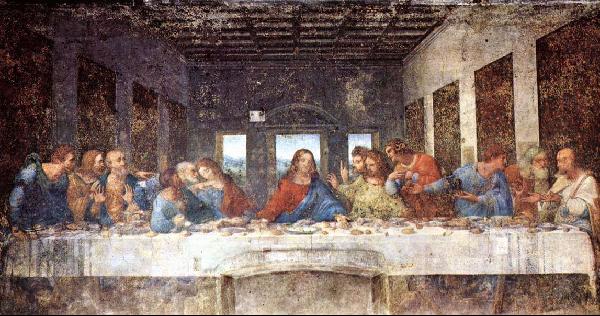
One of the great things about the celebration of The Lord’s Supper in the Protestant tradition is that it places everyone on an equal playing field. All are in need of Christ’s sacrifice. I saw this on Sunday night:

Every church in the world is trying to find ways to help their church be more of a community. But we’ve taken the community aspect out of Communion by making it solely an individual experience with God. Was this really everything Jesus had in mind?

The name communion inspires the thought of community, yet it is not a word I think of when it comes to the celebration of the Lord’s Supper as most churches practice it.

I wonder what would happen if we consciously celebrated Communion by emphasizing communion with others and with God…instead of the individualistic thing we have made it.

Wouldn’t that allow our churches to be places of community in practice rather than just in statement?

  • http://www.aworshipfulheart.typepad.com Jan Owen

    I’ve often told my team that communion is not an individual event. Maybe if communion is served in different ways it might help emphasize this – in groups, or even having people serve one another, or any number of other ways that emphasize the Body of Christ, as well as the body of Christ. If that makes sense. You should read “Life Together” by Bonhoeffer. He has a great chapter on communion in community – excellent reading!

  • http://theycallmepastorbryan.com theycallmepastorbryan

    Great post again Tyler!

    Depending on your theology, the communion thing can also mean common union – in the Pauline sense that we are united to Christ, and therefore united to one another. So it can have something deeper even than just the idea that we share a unity, to that in Christ we are unified to the trinitarian life and to each other.

    If we roll with that idea of union, we are a community and we care for others who aren’t like ourselves because in Christ we are connected to each other.

    I’m loving what your posting though bro. Keep it up!

  • http://jskogerboe.com Joshua Skogerboe

    Excellent! Thanks Tyler.

    I’m with you on this. We actually try to be creative with the way we receive the Lord’s Supper together at Living Hope Church. It is always a holy, reverent moment, but we vary how we take the elements. Sometimes one at a time with the pastor, single file in a line. Sometimes all together in our seats after having come up to receive the elements. Sometimes in a big mob together down in front. A picture of the church together.

    Last week we had a FUEL event – an environment to encourage and fuel up the passion tanks of our leaders, staff, and volunteers. We met in a large room in a huge circle around a central arrangement of candles. Very intimate even in a large group. And when we took communion, we had half the room at a time come and receive the elements from our Pastors in the middle, and then go serve someone else in the room, praying a blessing for each other. One on one, but in community. It was powerful, beautiful, amazing.

    We deeply get the COMMUNITY part of COMMUNION at our church. I’m so glad. Thanks for a great post again, brother.

    -joshua

  • Jay

    Good post. Communion has always been something that is pretty important at our church. We used to hold one service from time to time outside of the Sunday services that would focus on communion. We’ve stopped that and now once a month in every Sunday service we do communion.

    This past time, for the first time, our Pastor had the entire congregation read along with him from the Bible which I felt was an excellent thing to do because of that sense of community it provided.

  • http://www.iBelin.me Roderick Belin

    Awesome post and wonderful contribution to the conversation on emphasizing the power (or opening ourselves to the power) of the sacrament of Holy Communion. I’ll be sharing this with the congregation I’m blessed to serve.

  • Chad Boudreaux

    Thanks, Brethren. I was needed some thought for tmrw’s Communion. Communion=common unity will resonate well with our church family. Peace.

© 2009-2011 by Tyler Braun.   Powered by Wordpress.   Designed and coded by Paul Bae.